Sleeve packs
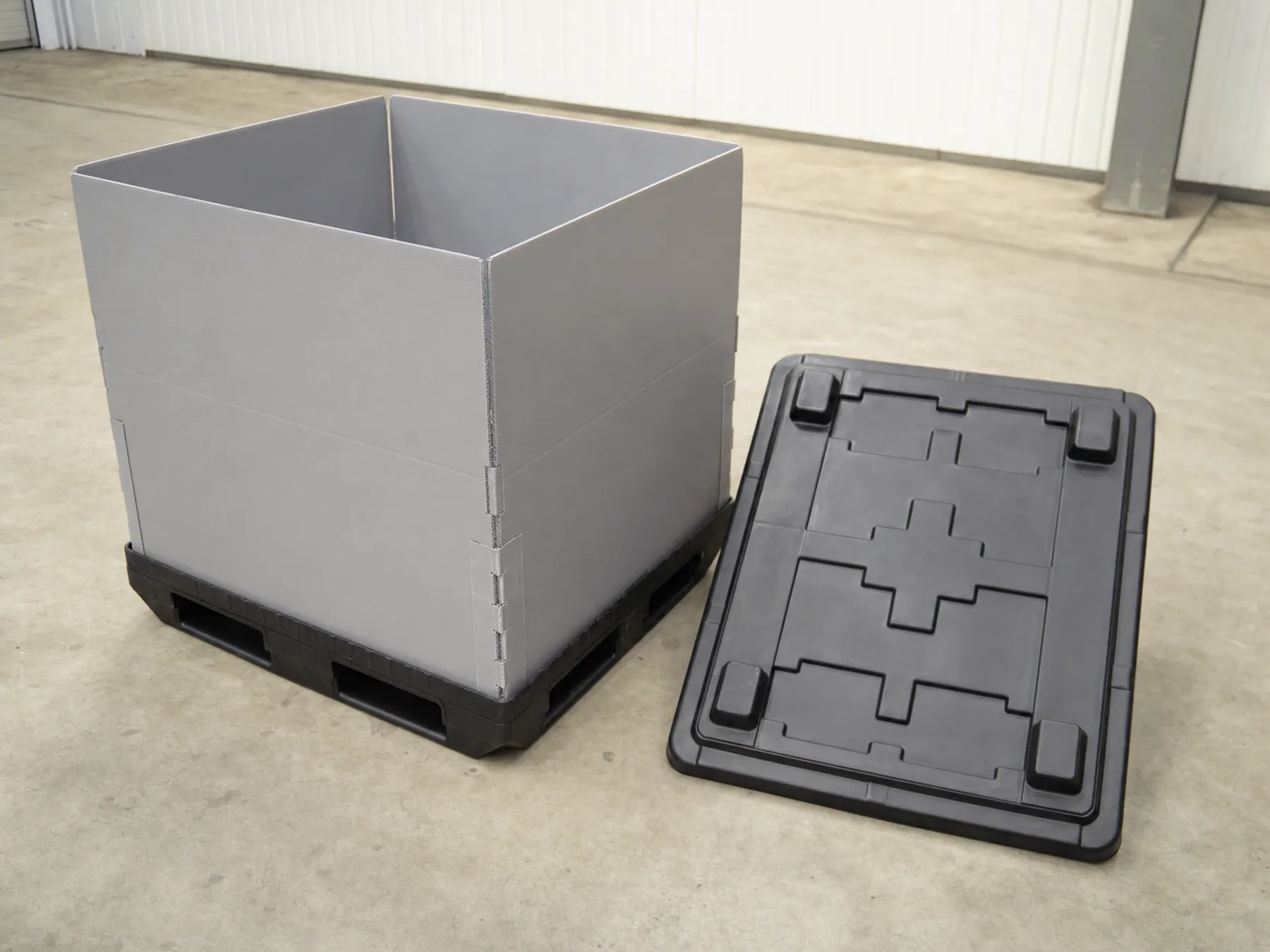
A sleeve pack is three parts that make a container: a plastic pallet base, a removable sleeve for the walls, and a lid. Lift the sleeve off and the load sits on an open pallet, which is the point of it.
Specifications
| Line | Imperial | Metric |
|---|---|---|
| Pallet base | Footprint and how it is handled (forks, jack, conveyor) | – |
| Sleeve | Height you need, solid or with an access flap | – |
| Lid | Matched to the base footprint | – |
| Load | Your heaviest fill, written into the quote | – |
| Return | Sleeve folds or nests onto the base for the trip back | – |
Metric figures are converted from the maker's imperial figures (1 in = 25.4 mm, 1 lb = 0.4536 kg, 1 US gal = 3.785 L) and rounded. Sources last reviewed 14 November 2026.
Footprints it comes in
Options
- Sleeve height
- One base can take sleeves of different heights. Pick the height for the part, not the other way round.
- Access flap
- A flap in the sleeve does what a drop door does on a one-piece container.
- Inserts
- Dividers and dunnage sit inside the sleeve and come out with it.
- Lid
- Required if anything stacks on top in transit.
When a sleeve pack beats a one-piece container
When the part is unloaded by lifting it off rather than reaching in. Large stampings, glass, molded panels and racks of components come off an open pallet more easily than out of a box. Take the sleeve away and a hoist or a robot has clear access from every side.
It also helps when one base has to serve several parts. Change the sleeve height or the inserts and the same base and lid go round a different loop.
What it costs you
Three parts to count instead of one, and a lid that has to stay with its base. On a loop with many partners that is a real job; see sleeve pack or one-piece before you decide.
How we quote it
Figures vary a lot from maker to maker, so we don't print one here. Send the footprint, sleeve height, heaviest fill and how many sets, and the quote carries the load ratings and trailer count for the parts we name.
Questions about sleeve packs
- Can a sleeve pack go in racking?
- The base is a plastic pallet, so it can if it is rated for racking. Ask for the racking rating of the base we name.
- Do sleeves come in different heights for one base?
- Often, yes. That lets one base and lid carry tall and short loads; tell us the heights you need.
- How is the sleeve held on?
- It locates on the base and is held by the lid or by clips. In transit, a stack is usually strapped through the base and lid.
- Can a sleeve pack be washed?
- Yes. The three parts come apart, which makes washing them simpler than washing a one-piece container with hinges.
- How are sleeve packs held together in transit?
- Usually by the lid pressing the sleeve into the base's groove, plus straps or bands around the whole pack. Some designs use clips or latches moulded into the base. On a long trip, band them; a loose lid lets the sleeve lift out when the trailer bounces.
- Can the sleeve be printed or labelled?
- Yes. Corrugated sleeves take print readily, which suits one-way export with shipping marks. Plastic sleeves take labels in a holder or adhesive placards that survive washing better than paper.
- What happens to the parts when the pack is empty?
- Base, sleeve and lid stack together, the sleeve folded flat between base and lid, so one empty pack is roughly as tall as the base plus a few inches.
- Can a sleeve be replaced alone?
- Yes, buy new sleeves as they wear.