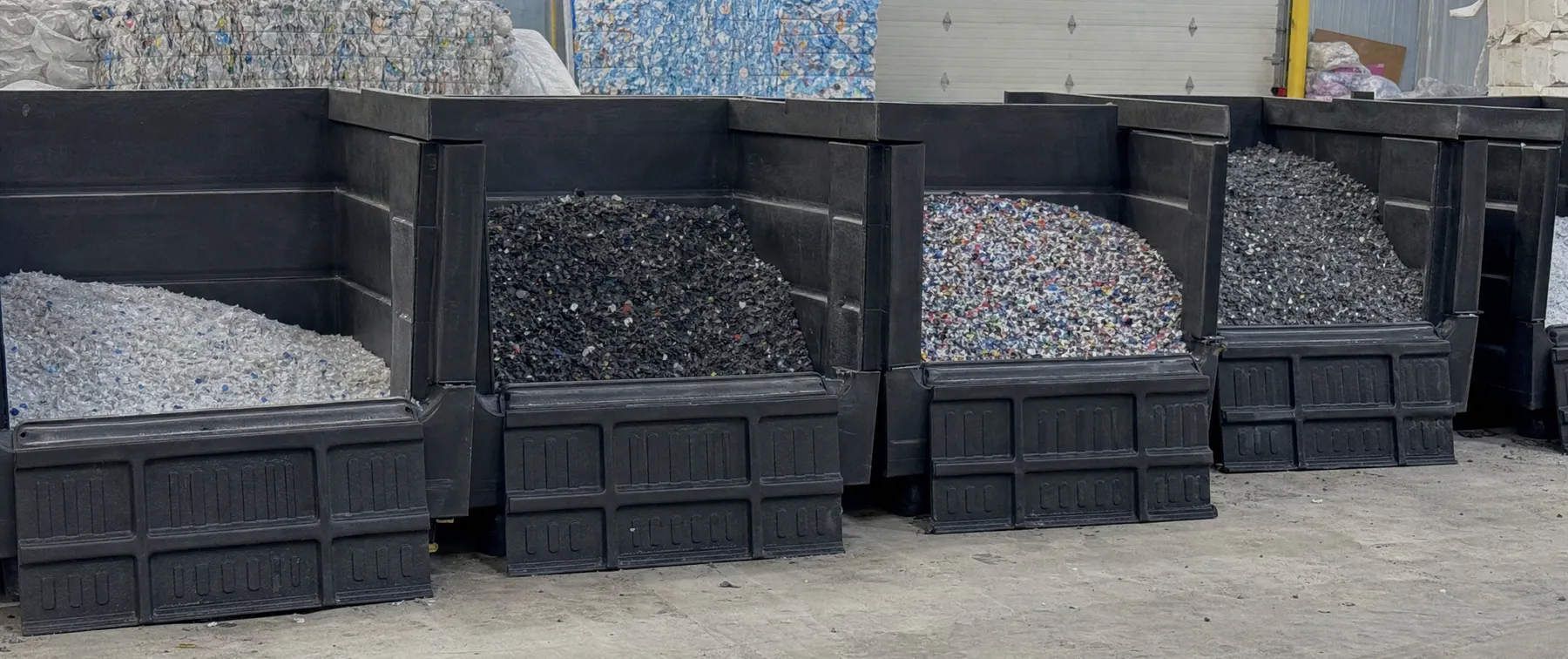
Bulk containers for plastics and resin plants
Plastics plants fill bulk containers at both ends of the process. Pellets and regrind come in and go to the hopper; molded parts come off the press and go out to the customer. Both are light for their volume, which is why plastics plants lean towards tall containers.
Containers that suit it
Tall collapsible
About 46 in tall, 40.5 cu ft, 2,000 lb, top discharge, folding to 13.8 in. Light, bulky product fills it before it gets heavy.
Collapsible bulk container
For molded parts going to a customer and coming back empty.
Lids
To keep dust off pellets and finished parts.
What to ask for
- A liner that fits
- For pellets, powder and regrind. Quote it with the container so it matches the inside size.
- Discharge
- Top, or a bottom or side opening for a hopper. Say how the container empties.
- Dunnage for molded parts
- Dividers or layers so cosmetic surfaces don't rub in transit.
- Return ratio
- For a tall container it is better than for a short one: 3.3:1 on the 46 in example.
Where the industry is
Among the states on our area pages, plastics product manufacturing employs the most people in Ohio (42,286 jobs), Pennsylvania (34,094), Indiana (33,122) and Michigan (32,916), followed by Wisconsin and North Carolina. The counts are private-sector jobs in 2025 from the Bureau of Labor Statistics' Quarterly Census of Employment and Wages (BLS QCEW 2025, NAICS 3261).
The plastics belt overlaps the auto belt, so many molders here ship parts to automotive plants in their own returnable containers.
Regrind and scrap loops
Molders often send scrap runners and rejected parts back to a grinder, or out to a recycler, in the same containers. A dedicated colour for scrap keeps it from being mixed with good parts or virgin pellets.
Static and dust
Dry pellets and powders build static and dust as they move. A liner keeps dust in the container and off the walls; ask whether the maker offers an anti-static grade if your product or your area calls for it.
Weights
Pellets are light for their volume, so a tall container fills before it reaches its 2,000 lb rating. Molded metal-insert parts and dense compounds can reverse that; send the weight of a full container if you know it.
Keeping pellets clean
Contamination is the worry in a molding plant. A pellet of the wrong colour or grade can spoil a run of parts, so bins that carry resin or regrind should be cleaned out between materials and kept lidded where dust is a problem. A liner simplifies changeovers: when the bin is emptied, the liner goes and the bin is ready for the next material.
Static and fines
Dry pellets moving by vacuum through a hopper can build static and leave fine dust behind. Some plants ground their bins or use liners rated for static; tell us if yours does, and we look for the right option.
Regrind and scrap
Sprues, runners and rejected parts are ground and often fed back into the press. Grinders produce a lot of dust and fines, so a lidded container next to the grinder keeps the floor clean and the regrind dry. Label containers by material and colour so regrind goes back into the right press.
Finished parts
Moulded parts leaving the press are often still warm and can scuff or warp if piled carelessly. Many molders use dividers or bags inside the container for cosmetic parts and plain bulk for hidden ones. Plan the height so a worker can reach the bottom without a drop door, or add one.
Gaylord tilters and vacuum loaders work with plastic containers too.
Tell us what goes in, how the container empties and how many. Ask for a quote