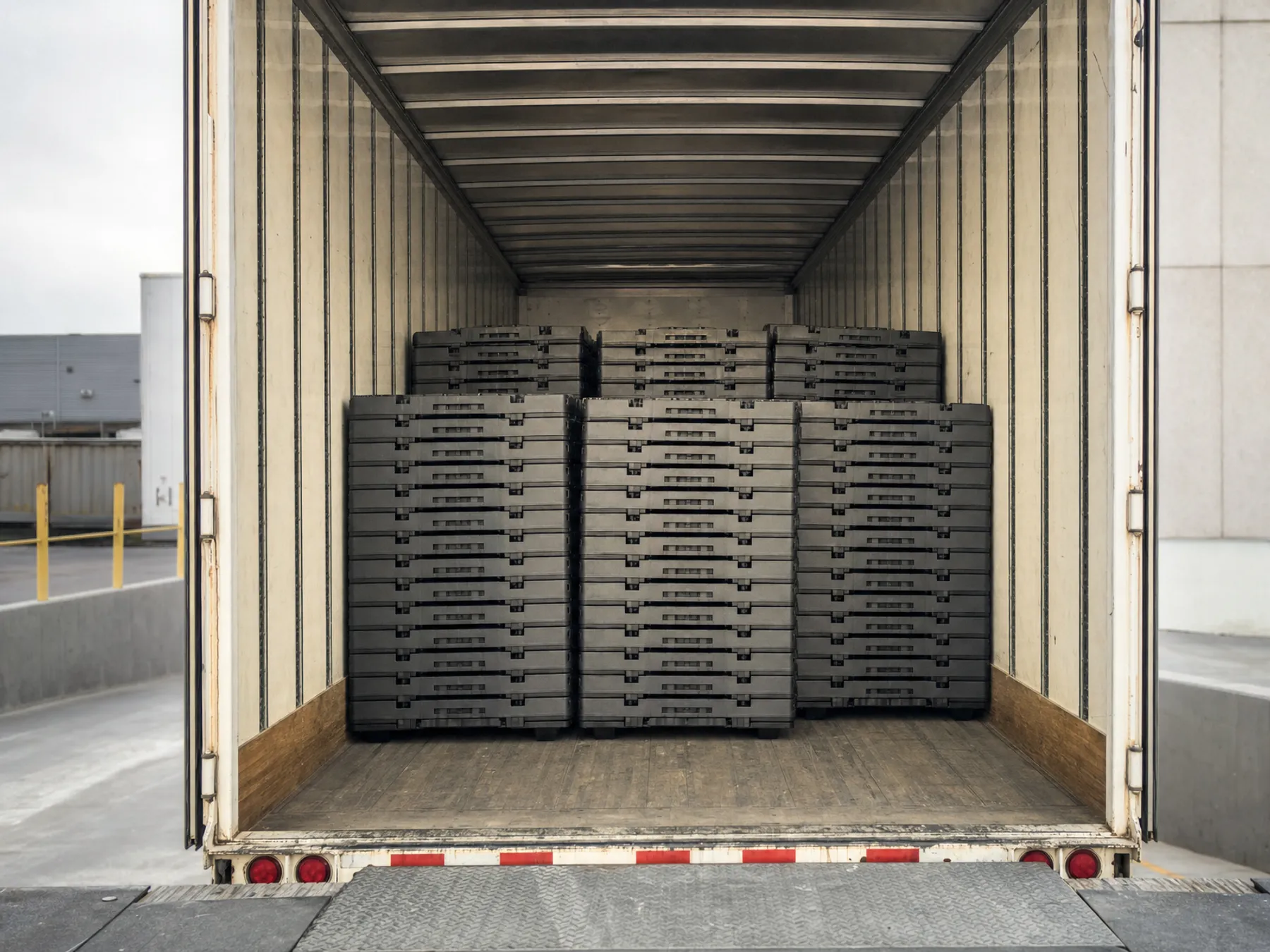
48 x 45 in plastic bulk containers
48 x 45 in is the footprint with the most models in the ORBIS bulk range, 17 when we last counted. It is five inches deeper than a GMA pallet, which is room for one more row of parts, and it is the size automotive and parts loops tend to standardise on.
Heights it comes in
- 25 in
- 29 in
- 33 in
- 34 in
- 39 in
- 42 in
- 48 in
- 50 in
From Container Exchanger plastic gaylord page, reviewed 14 November 2026.
Containers made on it
- Collapsible containerThe usual build on this footprint, in heights from 25 to 50 in, with drop doors and card holders as options.
- Fixed-wall containerFor parts that stay on one plant floor, where folding walls only add hinges to wear.
- Sleeve packA base, a sleeve and a lid, for parts lifted off rather than picked out.
What it fits
The extra five inches matter in two places. In racking built for 40 in deep pallets the container overhangs the beam by more than a 48 x 40 would, so check the rack depth and whether the overhang is front or back. On a trailer the 48 in side still runs across, two to a row, but each row is longer, so a trailer holds fewer rows than it would of 48 x 40.
Line-side, the depth suits stations that were laid out around this container in the first place. If your customer already ships to you in 48 x 45 containers, matching their footprint keeps your dunnage, labels and rack slots interchangeable with theirs.
Many North American auto plants name this footprint in their packaging guidelines, and suppliers who ship to more than one plant tend to buy it for that reason. Across a trailer, two fit side by side either way round; check the exact model's outside dimensions, which run a little over the nominal size, before planning a load.
If a customer's packaging guidelines name a different footprint, follow theirs; we quote whichever one they specify.
Supplier packaging manuals usually state the container's footprint, height and labelling rules.
Order dunnage with the containers.
The extra five inches over 48 x 40 suits parts such as door panels, fascias or wheel housings that need a little more depth when laid at an angle.
Questions about 48 x 45 in
- Why 45 in rather than 40?
- Line stations and parts were laid out around it. The extra depth holds one more row of many automotive parts, and once a plant's racking and dunnage are built for it, the whole supply chain follows.
- Will it fit racking built for 48 x 40 pallets?
- Usually, with five inches more overhang on the beams. Check that the rack depth and any decking allow it, and that the container's base is rated for racking.
- Does the 48 x 45 come with drop doors?
- Many models do, on one long side or both. Choose the side your pickers face at the station.
- Why 45 in rather than 40?
- The extra width fits the parts and dunnage automotive programmes were designed around, and two still sit across a standard trailer. Suppliers shipping to several assembly plants often keep one fleet in this size so containers can move between customers without repacking.