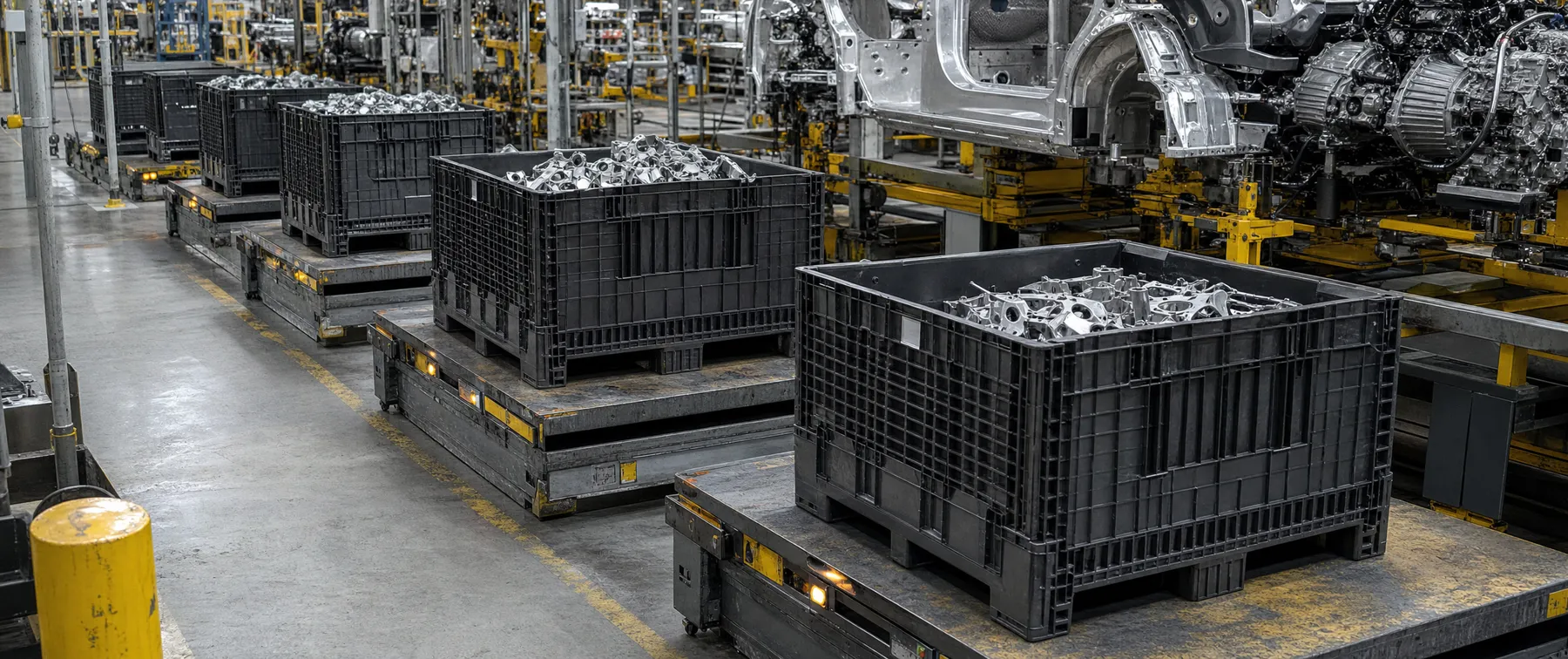
Bulk containers for automotive parts
Automotive plants and their suppliers run parts round a closed loop: the supplier fills a container, the plant empties it at the line, and the empty goes back to be filled again. That loop is what plastic bulk containers were built for, and it is why parts plants buy collapsibles by the trailer rather than corrugated by the pallet.
Containers that suit it
Collapsible bulk container
The loop container. It folds for the trip back, so empties cost a fraction of the freight full containers do. 48 x 45 in is the common footprint on auto lines; 48 x 40 in where the plant runs GMA racking.
Sleeve pack
For stampings, glass and large molded parts that come off by hoist or robot. Lift the sleeve and every side of the load is open.
Long footprints
Bumper beams, door panels and long harnesses go in 56 to 78 in long containers on a 48 in width.
What to ask for
- Collapsed height and return ratio, per footprint
- The two numbers that set the cost of empties. For a 48 x 40 x 32 in collapsible, 13.5 in and 2.32:1.
- Dunnage
- Dividers, racks or bags that hold the part so it arrives undamaged. Send a drawing or photo of the part and how many go in a container.
- Card holders
- Where the routing or Kanban card sits, so every container in the loop can be read at the dock.
- Static and dynamic stacking
- How high full containers may go in the warehouse and on the truck. Transit stacking is always lower.
Where the industry is
Among the states on our area pages, motor vehicle parts manufacturing employs the most people in Michigan (111,465 jobs), Ohio (62,025), Indiana (52,146) and Tennessee (38,791), followed by Kentucky, Alabama, Texas and South Carolina. The counts are private-sector jobs in 2025 from the Bureau of Labor Statistics' Quarterly Census of Employment and Wages (BLS QCEW 2025, NAICS 3363).
Michigan's parts employment is 7.5 times the national share; the Detroit metro's is 9.4 times. Most of these plants sit along I-75 and I-65, which is where the longest loops run.
Matching your customer
If you supply an assembly plant, the plant often sets the container: its footprint, its height, sometimes its colour and the card holder. Send us the plant's packaging specification if you have one and we quote to it. If you set the loop yourself, start with the part and the line station and we work out the container from there.
Containers that come back damaged
On a busy loop, some containers come back with a cracked wall, a bent latch or a broken door. Agree with your supplier who inspects returns and where damaged ones go, and keep a stock of latches and pins. A container repaired in an hour is cheaper than a new one.