How many bulk containers fit on a truck
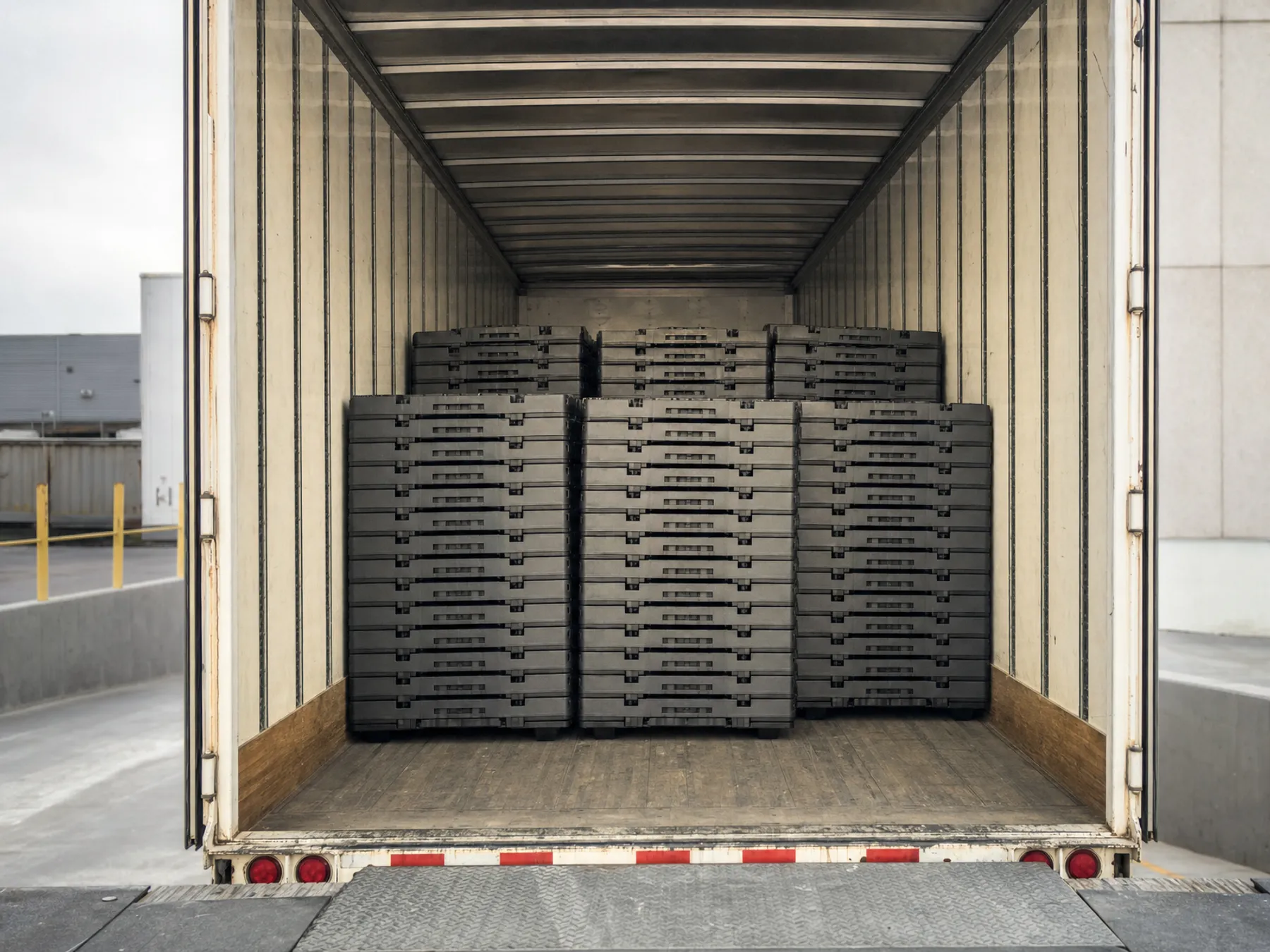
On a 53 ft trailer, a 48 x 40 x 32 in collapsible ships 90 assembled or 240 folded; a 46 in tall collapsible up to 240 folded; a folding field bin 330 folded; and nesting macro bins about 150 to a truckload. Those are makers' figures for specific models.
The figures, by container
| Container | Per 53 ft trailer | Source |
|---|---|---|
| 48 x 40 x 32 in collapsible | 90 assembled; 240 collapsed | ORBIS AG4048-32 product page |
| 48 x 40 x 46 in tall collapsible | Up to 240 collapsed without lids; 210 with lids | Buckhorn Intrepid listing at CustomMHS |
| 48 x 40 x 32 in folding field bin | 330 folded | Rehrig Pacific 40 x 48 field bin page |
| 48 x 40 x 31 in macro bin | 150, nested | SJF MACX bin listing |
Why the same trailer gives different numbers
Three things set the count. The footprint sets how many fit on the floor. The height sets how many stack in the trailer's height. And the empty state, folded, nested or neither, sets how small each one gets. A folding field bin folds to 10 in, a collapsible to 13.5 or 13.8 in; a macro bin doesn't fold at all but nests part-way into the one below.
Lids cost space. On the tall collapsible, carrying the lids with the empties drops the count from 240 to 210.
And corrugated gaylords?
Flat corrugated boxes ship in much larger numbers per truck than any plastic container, because a flat sheet of board is thin. The figure that matters isn't the count on the inbound truck; it is that a plastic container comes back to be reused and a box doesn't. See plastic vs corrugated.
For your quote
Trailer counts depend on the exact model and how it is loaded, so we write the maker's figure for the model we quote, assembled and empty, rather than a rule of thumb. Order quantities that fill whole trailers usually make the freight cheaper per container.
What a 53 ft trailer is
The figures here are for the standard 53 ft dry van, the trailer most US freight moves in. Inside, it is roughly 52 ft long and between about 98 and 101 in wide depending on the trailer, with a door opening a little lower than the inside height. Two 48 in wide containers fit side by side across it. Refrigerated trailers have thicker walls, so they are a little narrower inside; check the count with the carrier if your containers travel cold.
Weight can run out before space
A trailer has a legal weight limit as well as a volume. Empty containers never come close to it: 240 folded collapsibles at a few hundred pounds of plastic per stack are light freight. Full ones can. Ninety containers each carrying 1,500 lb would be 135,000 lb of product, far over what a road trailer can carry. Full loads are usually limited by weight, which is why the makers' trailer counts are quoted for empties and assembled empties, not for full containers.
Stacking on the trailer
How high containers stack on a trailer depends on their dynamic rating, not their static one. A tall collapsible rated two high in transit (Buckhorn Intrepid listing at CustomMHS) can't be loaded three high to fill the trailer's height, even if they would fit. Lids help a stack sit flat and carry the load evenly.
Banding folded containers
Folded containers usually travel in stacks, banded or strapped so they don't shift. Some makers mould strapping slots into the base and lid for this. Ask how many folded containers make a stack for the model we quote, because that sets how the trailer is loaded and unloaded by forklift.
Mixed loads
Not every trailer of empties is one model. If two partners return different containers on one truck, the count is whatever fits of each, and the folded heights have to stack well together. Keeping one model per loop keeps the arithmetic simple.
Shorter trailers
On a 48 ft trailer or a straight truck, the count is lower in proportion to the floor length. Ask us to work it out for your equipment.
Ocean containers
A 40 ft high-cube shipping container is about 92 in wide and 105 in tall inside, narrower and a little lower than a typical dry van, and its doors are smaller than its interior. Counts per box are lower than per trailer, and folded empties must be loaded through the doors by hand-pallet truck or forklift with care. Ask us for an ocean count separately.
Load bars and securing
Plastic containers slide on a trailer floor more easily than wooden pallets. Drivers use load bars or straps across the rear rows, and some shippers add friction sheets between layers. A load that shifts under hard braking can crack walls or spill parts.
Floor loading versus dock height
Some yards have no dock and load from the ground with a forklift reaching into the trailer from the side or rear. That limits how high and how far back containers can be placed and lowers the count. Tell us if yours is a ground-level yard.
Reefers
Refrigerated trailers have thicker insulated walls, so their insides are narrower and lower than a dry van's. Expect fewer containers per load; ask us for a count on your reefer.
Weigh stations
Full loads of dense parts can approach the legal gross weight limit, 80,000 lb on interstates for a standard rig. Ask your carrier where yours sits.
Terms used here
- Footprint
- Length by width of the base, e.g. 48 x 45 in; it must match the racking, line positions and trailer pattern.
- Collapsed height
- The container's height with walls folded down; with the footprint it decides how many fit on a trailer.
- Return ratio
- How many collapsed containers fit in the space of one assembled one, e.g. 2.32:1 or 3.3:1; sets the cost of sending empties back.
- Static / dynamic load
- Static: what the container bears stacked in storage. Dynamic: what it bears moving or stacked in transit, which is lower.
- Macro bin
- A harvest bin for orchards and packing sheds, solid or vented, usually 48 x 40 or 48 x 48.
Ask in truckloads if you like; we quote the trailer count for the model with the price. Ask for a quote