Plastic vs corrugated gaylords
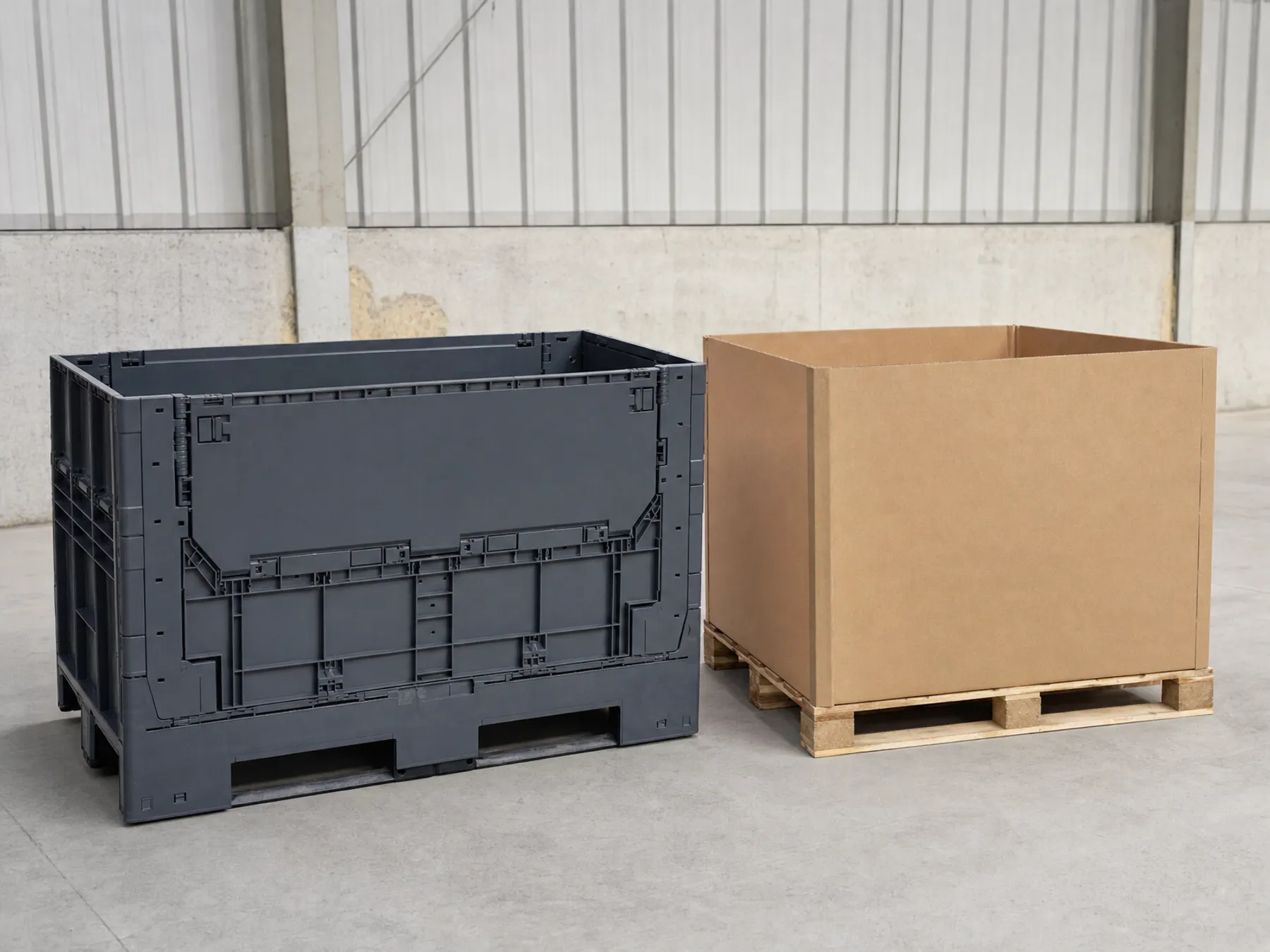
A plastic gaylord costs more to buy, carries more, can be washed and goes back folded for reuse; a corrugated gaylord costs less, is used once or a few times, and goes in the baler. If your containers come back to you, plastic usually pays. If they never come back, corrugated usually wins.
Same footprint, different life
Both sit on the same footprints, most often 48 x 40 in, so the line, the racking and the truck don't change when you switch. What changes is how long the container lives. A corrugated box is a consumable: you buy it, fill it, ship it and the customer throws it away. A plastic pallet container is equipment: you buy it once and it goes round and round.
Capacity, and what water does to it
Plastic pallet containers are generally rated 1,500 to 2,500 lb, according to Container Exchanger plastic gaylord page. A corrugated box's strength depends on its board and on how dry it is. Leave a corrugated gaylord on a wet dock or in a cooler and it loses strength; a plastic one carries the same load wet or dry.
Washing
A solid-wall plastic container can be hosed down or put through a washer. That is why food, meat and ingredient plants switch first: a corrugated box that has held food is hard to clean and can't go back into a food zone. If you run a tunnel washer, tell us its water temperature and detergent, and we check them against the maker's cleaning guidance for the model we quote.
The trip back
Corrugated goes flat too, but usually into a baler. A collapsible plastic container goes flat and gets refilled. One 48 x 40 x 32 in collapsible folds to 13.5 in, and a 53 ft trailer holds 240 folded against 90 assembled, according to the ORBIS AG4048-32 product page.
When corrugated is still the better buy
- The container leaves and never comes back: one-way shipments to customers who won't return it.
- Volumes are low or irregular, so a fleet of plastic containers would sit idle.
- The product is light and dry and the box only has to survive one trip.
Between those and a closed, regular loop sits a grey area. The way through it is to count trips: how many times would one plastic container go round in a year, and what do you spend on boxes for that many trips? We put the plastic side of that sum in the quote. The corrugated side is your own purchasing figure.
Handling and safety on the floor
A corrugated gaylord needs a pallet under it, and usually banding or stretch film to hold the box to that pallet. Forks go into the pallet, not the box, and a box that has sat in damp air can sag or split when it is lifted. A plastic pallet container has its base moulded in, so the forks go straight into the container and there is nothing to strap. Walls don't bulge as they fill, which keeps a stack square.
Staples and box cutters go away too. Many plants switched for that reason alone: fewer cuts on the line, no staples in the product, no cardboard dust in a clean room.
Storage when empty
Flat corrugated takes little floor until it is set up, then it is a box. Plastic containers take a footprint each, even empty, but a collapsible folds back down, so one footprint stores several empties on top of each other: a 48 x 40 x 32 in model is 13.5 in tall folded, and macro bins nest. A fixed-wall bin can't fold and needs full space empty, which is fine on a floor where it never stops moving. A plant short of floor space should count where folded empties will wait, and how many, before switching.
Waste and recycling
Corrugated is widely recycled, but it still has to be broken down, baled and hauled. A plastic container that has reached the end of its life is usually HDPE or polypropylene, which recyclers take as well. In between, it doesn't enter the waste stream at all. If your site reports packaging waste, the switch shows up there.
Running both for a while
Most plants don't switch overnight. A common path is to move one loop first, often the busiest supplier, with the same footprint so racking and labels don't change, then extend it once the returns are working. Ask for a quote on that first loop rather than the whole plant.
Weather and outdoor yards
Corrugated left outside soaks up rain and loses strength fast. Plastic shrugs off the rain, though bins stored in strong sun need UV-stabilised resin to keep from going brittle over the years. Ask for that resin in the quote if your bins live in an open yard in the South or West.
When one gets damaged
A torn or crushed corrugated gaylord is simply thrown away and replaced from the next delivery. A plastic container with a broken latch, a bent hinge pin or a cracked door can usually be repaired with parts from its maker, and one past repair goes to a plastics recycler rather than a landfill. Keep a few spare latches and pins at each end of the loop.
Who pays for what
With corrugated, the shipper buys boxes and the receiver pays to bale them. With plastic, someone owns the fleet and someone pays to send empties back. Agree both, in writing, with the receiving plant and the carrier before the first load.
Send your footprint, heaviest fill and how many trips a year, and we quote the plastic side. Ask for a quote